
Continuous granulation process section
Continuous Granulation System for Pharmaceutical Powder Processing
A continuous granulation process section for pharmaceutical powder processing projects where feeding, wetting, granulation, discharge and downstream integration must be technically evaluated.
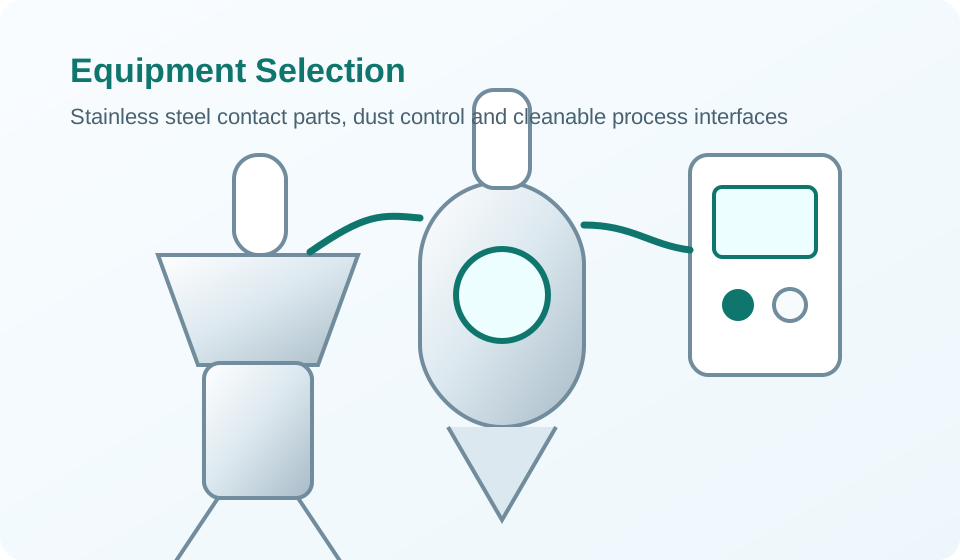
Continuous Granulation Section
Process-section configuration for feeding, wetting, granulation and discharge evaluation.
A continuous granulation system is used for pharmaceutical powder processing when the project requires continuous feeding, wetting or granulation and downstream discharge or sizing. It is positioned as a process-section equipment solution and can be evaluated together with upstream and downstream process requirements.
Product Quick Summary
Application
Continuous granulation
Process type
Continuous powder feeding, granulation and downstream process integration
Key evaluation
formulation, feed rate, wetting route, granulation behavior, process control and downstream equipment
Capacity
depending on material characteristics and model selection
Support
process-section evaluation, formulation review and documentation support available if required
Process position
Where A Continuous Granulation System Fits In The Process
The system is positioned after raw material feeding and before drying, milling, sieving, blending or final feed, depending on whether the process uses wet or melt granulation.
Step 1
Metered feeding
Step 2
Continuous mixing
Step 3
Granulation
Step 4
Drying or cooling
Step 5
Milling and transfer
Definition
What Is Continuous Granulation System?
A continuous granulation system is a process-section concept that combines controlled feeding, granulation and downstream handling for OSD manufacturing development.
A continuous granulation system is used for pharmaceutical powder processing when the project requires continuous feeding, wetting or granulation and downstream discharge or sizing. It is positioned as a process-section equipment solution and can be evaluated together with upstream and downstream process requirements.
Final equipment configuration and performance should be confirmed according to material characteristics, process requirements and technical evaluation.
Working principle
How Continuous Granulation System Works
Materials are metered continuously into the process, mixed or granulated under controlled conditions, then transferred to drying, cooling, milling or collection according to the process route.
The practical result depends on material behavior, selected model, operating parameters and how the equipment connects with upstream and downstream process steps.
Powders are metered continuously into the process
Liquid, melt or process energy is introduced according to the route
Granules are formed under controlled process parameters
Downstream drying, cooling, sizing or transfer is configured by project scope
Applications
Typical Applications
Continuous OSD granulation process evaluation
Wet granulation or melt granulation workflow review
Sustained or controlled release formulation projects
Pilot scale-up before commercial production
Integration with drying, milling and transfer equipment
Material review
Suitable Materials
Material suitability should be reviewed by formulation, moisture, heat sensitivity, flowability, viscosity, solids content or other process behavior depending on the equipment type.
OSD powder blends for continuous granulation evaluation
Wet granulation formulations after process review
Melt granulation or hot melt extrusion formulations
Controlled release formulation systems
Pilot and production scale-up materials after testing
Process output and capacity
Process Output & Capacity
A continuous granulation system is selected for continuous process development or production sections. Output depends on formulation, feed rate, liquid or melt addition, granulation mechanism and downstream handling.
Granule size depends on formulation, feed rate, liquid or melt conditions, screw or mixing configuration and downstream milling or sieving. Testing is recommended for target granule properties.
Capacity depends on process route, model selection, feeder range and downstream equipment. Catalogue data covers lab to production extrusion/granulation models, with exact throughput confirmed by evaluation.
- Process objective
- continuous granulation process section
- Define whether the route is wet granulation, melt granulation or another evaluated concept.
- Control point
- metered feeding, wetting, granulation and discharge
- Process stability depends on formulation and control strategy.
- Capacity
- depending on formulation, feeder range and module selection
- Throughput should be confirmed by testing or technical evaluation.
- Downstream step
- drying, cooling, milling, sieving, blending or transfer
- Downstream interface should be defined before final scope.
Equipment value
Key Features
Process role
The system is positioned after raw material feeding and before drying, milling, sieving, blending or final feed, depending on whether the process uses wet or melt granulation.
- Metered feeding
- Continuous mixing
- Granulation
- Drying or cooling
- Milling and transfer
Main benefits
- Supports continuous process concepts instead of isolated batch steps
- Can be reviewed with upstream feeding and downstream sizing
- Useful for process development and scale-up studies
- Process-section concept can include configurable upstream and downstream interfaces
- Testing and technical evaluation are recommended before final scope
Line integration
- Feeding and discharge interfaces can be reviewed according to layout.
- Dust control, collection or wet-process auxiliaries can be configured where required.
- Final scope should be confirmed according to URS, process step and material behavior.
Configuration
Technical Options
Equipment options
- Lab, pilot and production process modules
- Loss-in-weight feeder and liquid addition review
- Extrusion, wet granulation or melt granulation route evaluation
- Drying, cooling, milling and sieving integration
- Control, recipe and documentation package options
Optional configurations
- Feeding and liquid addition modules
- Wet or melt granulation route review
- Drying, cooling, milling and sieving modules
- Process sensors and recipe controls
- Pilot testing and scale-up support
GMP-oriented review
Pharmaceutical Design Considerations
Project considerations
- Confirm process control strategy before final line design.
- Review cleaning and product changeover for each module.
- Coordinate drying, cooling, milling and transfer interfaces.
- Documentation support and FAT/SAT/IQ/OQ support are available if required.
Safe project wording
- GMP-oriented equipment design can be discussed according to customer URS and project requirements.
- SS316 contact parts are available for pharmaceutical applications.
- Dust control, containment, cleanroom compatibility and cleaning access should be reviewed according to the process step.
- Documentation support is available after order confirmation according to project requirements.
Project delivery support
Cleaning, Documentation & Validation Support
User manuals are supplied with the equipment.
FAT/SAT/IQ/OQ documentation, material certificates and validation-related documents can be provided after order confirmation according to project requirements.
Cleaning access, product-contact scope and changeover expectations should be reviewed before final configuration.
Feeding, dust collection and powder collection systems can be configured according to customer requirements.
Explosion-proof and nitrogen protection options can be discussed according to material and project requirements.
Testing and evaluation
Continuous Granulation Process Evaluation
Technical evaluation is recommended because formulation, feed behavior, wetting, granule formation and downstream sizing determine the final process concept.
Formulation and feed
Confirm formulation type, feed rate, flowability and liquid or melt addition requirement.
Granule target
Define target granule properties, downstream drying or cooling and sizing expectations.
Process section scope
Confirm whether the customer needs a module, process section or configurable upstream and downstream interfaces.
Selection logic
When to Choose Continuous Granulation System
Choose continuous granulation
Best for: continuous process development or production section
When to consider: when stable metered feeding and continuous granule formation are required.
Use with downstream modules
Best for: drying, sizing, sieving and transfer integration
When to consider: when the granulation section must connect to defined upstream or downstream equipment.
Run technical evaluation
Best for: new formulations or uncertain process behavior
When to consider: when process parameters are not yet confirmed.
Alternative selection
Related Equipment / Equipment Comparison
Melt Extruder
Consider when the process objective is hot melt extrusion rather than continuous granulation.
View detailsConical Mill
Consider for granule sizing after granulation or drying.
View detailsTurbo Sieving Mill
Consider for screening, classification or particle consistency after granulation.
View detailsRFQ checklist
What Information Is Needed for Quotation?
A stronger quotation can be prepared when the material, process objective, target output, capacity and documentation expectations are clear.
Formulation and process objective
- Formulation type and process objective.
- Temperature sensitivity, melting or softening behavior if relevant.
- Required throughput and operating hours.
- Screw, process section or granulation route requirement if known.
- Material testing or pilot evaluation requirement.
Line integration and delivery scope
- Upstream feeding method and downstream cooling, drying, sizing or transfer step.
- Utility, control, recipe and data recording expectations.
- Cleaning, product changeover and documentation requirement.
- Destination country, available layout, URS and BOQ.
- Whether the request is for one process module or a complete process section.
Internal links
Related Solutions and Guides
Material Testing & Equipment Selection
Best starting point when target particle size, material behavior, wet-process performance or equipment selection is uncertain.
View detailsGranulation & Drying Line
Related solution page for OSD granulation, drying, sizing and downstream powder handling concepts.
View detailsOSD Powder Processing Line
Related OSD process page for powder feeding, milling, sieving, blending, granulation and downstream handling.
View detailsPharmaceutical Powder Handling System
General pharmaceutical powder handling solution for transfer, containment, processing and line integration.
View detailsHow to Design an OSD Powder Processing Line
Guide for connecting powder processing equipment into an OSD manufacturing process concept.
View detailsWhat Information Is Needed for Powder Handling Quotation?
Checklist for preparing material, process, capacity, documentation and layout information before RFQ.
View detailsWhat Is Pharmaceutical Powder Handling Equipment?
Overview guide for powder handling, transfer, milling, sieving, blending and containment equipment.
View detailsFrequently asked questions
FAQ
What is a Continuous Granulation System used for?+
A continuous granulation system is used for pharmaceutical powder processing when the project requires continuous feeding, wetting or granulation and downstream discharge or sizing. It is positioned as a process-section equipment solution and can be evaluated together with upstream and downstream process requirements.
What information is needed for quotation?+
Please share material name, process objective, initial condition, target particle size or output requirement, capacity, cleaning expectations, documentation needs, destination country and any URS, layout, BOQ or test objective.
Is material testing recommended?+
Material testing is recommended when particle size, capacity, viscosity, heat sensitivity, flowability, dispersion behavior or process output is uncertain.
Can documentation support be provided?+
User manuals are supplied with the equipment. FAT/SAT/IQ/OQ documentation, material certificates and validation-related documents can be provided after order confirmation according to project requirements.
Can SS316 contact parts be provided?+
SS316 contact parts are available for pharmaceutical applications and should be confirmed together with product-contact scope, cleaning expectations and URS requirements.
Can optional configurations be discussed?+
Yes. Feeding, dust collection, powder collection, control system, cooling, explosion-proof, nitrogen protection or downstream integration options can be discussed according to material and project requirements.
How should the continuous granulation scope be defined?+
It is positioned as a continuous granulation process-section solution. Feeding, wetting, granulation, discharge and downstream interface requirements can be evaluated when the process scope is defined.
What process information is most important?+
Formulation type, feed rate, wetting route, target granule properties, downstream drying or sizing and documentation expectations are important for selection.
RFQ support
Send Process Information for Continuous Granulation Evaluation
Share formulation type, process route, required throughput, target granule properties and downstream process. Our engineer will review the continuous granulation section concept.