Testing and selection support
Material Testing & Equipment Selection for Pharmaceutical Powder Processing
Select suitable milling, sieving, micronization or powder processing equipment based on material characteristics, target particle size, capacity and process requirements.
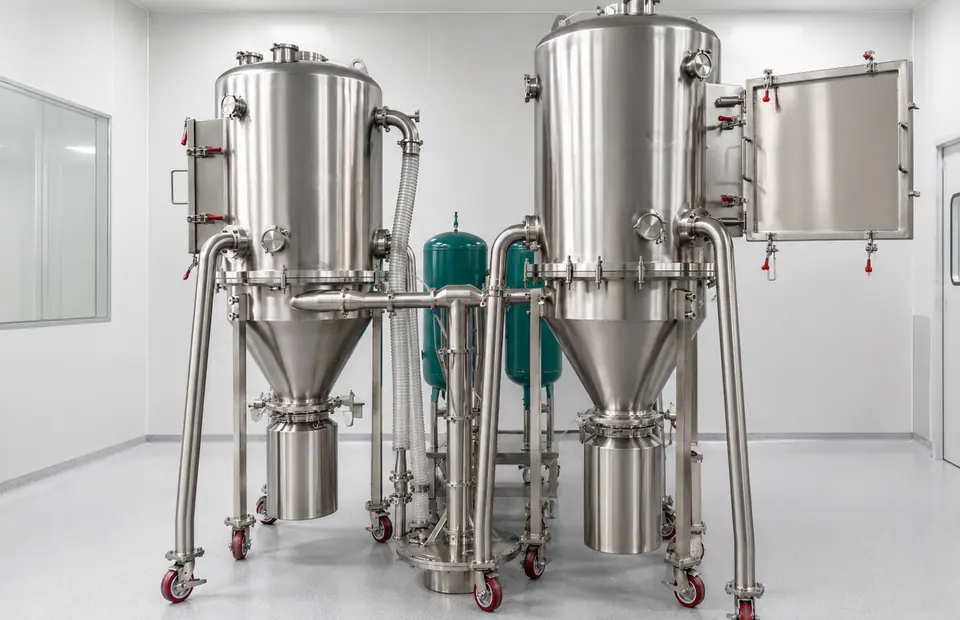
GEO Short Answer
What information is needed to select pharmaceutical powder milling equipment?
Equipment selection depends on material properties, initial particle size, target particle size, required capacity, process step, dry or wet processing, containment needs, cleaning requirements and pharmaceutical documentation expectations. Material testing is recommended when particle size, flowability or heat sensitivity is uncertain.
Why testing matters
Material Behavior Drives Equipment Selection
The same milling, sieving or wet grinding machine can produce different results with different powders. Testing reduces selection risk when particle size, heat sensitivity or flowability is uncertain.
Powder hardness, moisture, oil content, thermal sensitivity and flowability can change the result even when the same equipment type is used.
Initial particle size, agglomeration and product fragility influence whether impact milling, conical milling, sieving, jet milling or wet grinding is appropriate.
D50, D90 and D97 particle size targets should be confirmed by test data or technical evaluation when the result is critical.
API, DPI, OSD, food and fine chemistry applications can require different containment, cleaning, documentation and particle control strategies.
Target particle size should not be promised without testing when material behavior or process conditions are uncertain.
Selection guide
Equipment Selection Guide
Use this table to identify a likely equipment direction. Final model selection should be confirmed by material characteristics, testing or technical evaluation.
Requirement
Coarse size reduction
Recommended Equipment
Hammer MillTypical Use
Impact milling for dry, brittle, crystalline or fibrous materials.
Notes
Final particle size depends on material, screen, speed and feed rate.
Requirement
Controlled milling / delumping
Recommended Equipment
Conical MillTypical Use
Gentler powder delumping and wet or dry granule sizing.
Notes
Screen and impeller selection should be confirmed by process evaluation.
Requirement
Sieving / particle classification
Recommended Equipment
Turbo Sieving MillTypical Use
Control sieving, homogenizing and oversize removal.
Notes
Material test recommended for wet, sticky or blinding-prone products.
Requirement
Fine micronization
Recommended Equipment
Jet MillTypical Use
Fine API, DPI-related or high value powder micronization.
Notes
Particle size depends on gas pressure, feed rate, classification and material behavior.
Requirement
Wet grinding / nano dispersion
Recommended Equipment
Nano Bead MillTypical Use
Fine wet grinding and dispersion of suspensions or slurries.
Notes
Nano-scale targets require formulation review and material testing.
Requirement
Liquid-solid dispersion
Recommended Equipment
High Speed DisperserTypical Use
Premixing and dispersing powder into a liquid phase.
Notes
Often used before bead milling or wet grinding steps.
Requirement
Small batch wet milling
Recommended Equipment
Vertical Basket MillTypical Use
Flexible batch wet grinding and dispersion.
Notes
Suitable direction depends on vessel volume, viscosity and target fineness.
Requirement
Melt extrusion / continuous granulation
Typical Use
Thermal processing, wet or melt granulation and OSD process development.
Notes
Process route and throughput should be confirmed by technical evaluation.
Customer checklist
Information Needed From Customer
A strong inquiry does not need to be perfect, but it should provide enough material and process context for a useful equipment recommendation.
Material name
Industry: API / DPI / OSD / food / fine chemistry
Initial particle size
Target particle size
Required capacity
Dry or wet process
Heat sensitivity
Moisture / oil content
Bulk density
Flowability
Containment / dust control requirement
Cleaning requirement
GMP-oriented documentation needs
Layout / URS / BOQ if available
Whether sample testing is required
Testing workflow
Testing Workflow From Material Information To Quotation Proposal
The review path can stay lightweight for simple applications or include lab and pilot testing when particle size or process behavior is uncertain.
Step 1
Customer submits material information
Step 2
Technical review
Step 3
Recommended testing equipment
Step 4
Lab or pilot test if required
Step 5
Particle size and process result review
Step 6
Equipment model and quotation proposal
Pharmaceutical considerations
What The Engineering Review Should Include
Equipment direction should be checked against product contact, cleaning, containment, documentation and the surrounding process line.
Product contact material and surface finish expectations
Cleanability, changeover and access for inspection
Dust control during feeding, discharge and collection
Containment review for API or fine powders
Documentation support available according to project scope
FAT/SAT/IQ/OQ support available if required
GMP-oriented design review based on URS and process risk
Related equipment
Equipment To Review For Material Testing And Selection
Open each product page to compare working principle, suitable materials, particle size control and quotation inputs.
Impact milling equipment
Hammer Mill
A hammer mill uses high speed impact to reduce dry powders and brittle materials for pharmaceutical, API, nutraceutical and fine chemical processing.
View equipmentControlled delumping and sizing
Conical Mill
A conical mill sizes powders or granules through a selected screen using a rotating impeller, making it useful for controlled delumping and OSD granule conditioning.
View equipmentControl sieving and homogenizing
Turbo Sieving Mill
A turbo sieving mill uses a rotating sieve drum and stator tools to homogenize and control-sieve powders or granules before downstream processing.
View equipmentMicronization equipment
Jet Mill
A jet mill micronizes powders by accelerating particles with process gas so they collide and reduce in size without mechanical grinding media.
View equipmentWet grinding and nano dispersion
Nano Bead Mill
A nano bead mill uses small grinding media in a circulation grinding system to reduce particles in liquid suspensions and support fine dispersion targets.
View equipmentPremixing and dispersion equipment
High Speed Disperser
A high speed disperser uses a high speed shaft and dispersing disc to premix powders into liquids and prepare a uniform feed for wet grinding or formulation steps.
View equipmentBatch wet grinding equipment
Vertical Basket Mill
A vertical basket mill combines a grinding basket and dispersing action for batch wet grinding and fine dispersion where flexible vessel handling is required.
View equipmentHot melt extrusion equipment
Melt Extruder
A melt extruder processes powder or formulation blends through heated screw barrels to support hot melt extrusion, controlled release development and specialty dosage form evaluation.
View equipmentContinuous OSD process equipment
Continuous Granulation System
A continuous granulation system connects feeding, mixing, granulation and downstream handling steps to support OSD process development and scale-up.
View equipmentRelated knowledge
Related Knowledge Articles
Use these guides to understand powder handling basics, OSD process planning, mill comparison and RFQ preparation.
What Is Pharmaceutical Powder Handling Equipment?
Pharmaceutical powder handling equipment moves, conditions, weighs, contains and feeds powders between process steps while supporting dust control, cleanability, operator workflow and GMP-oriented documentation.
Read guideHow To Design an OSD Powder Processing Line
An OSD powder processing line should be designed around batch flow, room layout, powder behavior, containment level, cleaning method and interfaces from dispensing through final feed.
Read guideCone Mill vs Hammer Mill
Cone mills are often used for controlled delumping and granule sizing, while hammer mills are used for more aggressive size reduction. Selection depends on target particle size, heat sensitivity, containment and cleaning needs.
Read guideWhat Information Is Needed for a Powder Handling Quotation?
A useful powder handling quotation needs powder characteristics, process step, capacity, layout, containment level, cleanroom expectations, equipment interfaces and documentation requirements.
Read guideFAQ
Frequently Asked Questions
Do I need material testing before selecting a milling machine?+
Testing is recommended when the target particle size, flowability, heat sensitivity, moisture behavior or scale-up risk is uncertain. A preliminary equipment direction can still be reviewed from material data.
Can you guarantee the target particle size?+
No. Target particle size depends on material properties, equipment configuration and operating parameters. Critical D50, D90 or D97 targets should be confirmed by material testing or technical evaluation.
How do I choose between Hammer Mill and Conical Mill?+
A hammer mill is usually considered for stronger impact milling and more aggressive reduction, while a conical mill is often used for gentler delumping and wet or dry granule sizing.
When should I choose Jet Mill?+
A jet mill is normally reviewed when fine micronization is required and the product can be processed using gas-driven particle collision and classification.
What information is required for quotation?+
Send material name, initial and target particle size, capacity, process step, dry or wet condition, containment needs, cleaning expectations, URS, layout or BOQ if available.
Can the equipment support pharmaceutical documentation?+
Documentation support can be included according to project scope, including drawings, material certificates, FAT/SAT records and IQ/OQ support if required.
Final CTA
Send Your Material Information For Equipment Selection
Share your powder type, initial particle size, target particle size, required capacity, process step and available URS or layout. Our team will review the information and suggest suitable equipment or a testing plan.