
Enclosed powder conveying equipment
Pharmaceutical Vacuum Conveyor
Pharmaceutical vacuum conveyor for enclosed powder transfer from bag dump stations, IBCs, mills, sifters and process equipment.
Short Answer
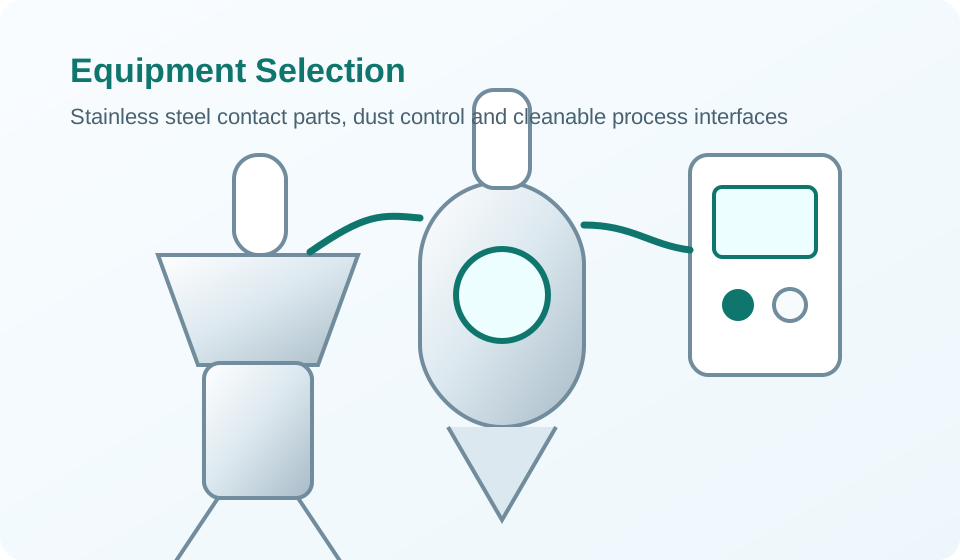
A pharmaceutical vacuum conveyor transfers powders through enclosed pipework to reduce manual handling and support dust-controlled feeding of process equipment.
Process position
Process Position
The conveyor connects pickup points such as bag dumping stations, drums or IBCs to receivers above mills, sifters, blenders, granulators, dryers or packing equipment.
Step 1
Pickup
Step 2
Vacuum line
Step 3
Filter receiver
Step 4
Discharge
Step 5
Equipment feed
Applications, Benefits And Technical Options
Applications
- Charging high shear mixer granulators
- Feeding vibro sifters and cone mills
- Transferring powders from bag dump stations
- IBC discharge to process equipment
- Powder feed between different floor levels
Key Benefits
- Closed conveying route for dust-sensitive powders
- Flexible pipe routing in compact process rooms
- Reduced operator lifting and open transfer
- Receiver and filter options matched to powder behavior
- Can be integrated into larger powder handling systems
Technical Options
- 316L contact parts and hygienic clamp connections
- Filter cartridge, reverse pulse cleaning and HEPA exhaust options
- Butterfly, flap or rotary discharge valve
- Mobile or fixed receiver arrangements
- PLC controls, level probes and upstream interlocks
Quotation input
What Information Is Needed For Quotation
A clearer URS and layout package helps the engineering team confirm equipment scope, capacity assumptions, containment expectations and documentation needs.
Product name, powder properties, bulk density, particle size range and flowability notes.
Required capacity per batch or per hour, target transfer distance and elevation.
Process layout, room classification expectations and upstream/downstream equipment interfaces.
Containment, dust extraction, cleaning, material contact and documentation expectations.
Utilities, control preference, automation scope and FAT/SAT/IQ/OQ support requirements.
Ready To Discuss A Powder Handling Project?
Send your URS, layout, BOQ, powder characteristics or required capacity. Our engineer will review the process step and suggest suitable powder handling equipment or a complete processing line concept.
FAQ
Frequently Asked Questions
Can a vacuum conveyor handle fragile granules?+
It may be possible with careful velocity and route selection. Fragility, particle size and acceptable breakage should be reviewed before selection.
What affects conveying capacity?+
Capacity depends on powder density, line length, vertical lift, bends, receiver size, filter area, discharge valve and vacuum source.
Can the solution be adapted to an existing production room?+
Yes. Layouts can be reviewed around existing rooms, ceiling height, operator access, utilities and equipment interfaces before a final proposal is prepared.
Related guides
Related Guides
Use these Knowledge Hub articles to compare equipment options, prepare RFQ inputs and connect this page to the wider powder handling process.
Vacuum Conveyor vs Pneumatic Conveyor
Vacuum conveying is commonly selected for enclosed pharmaceutical powder transfer over practical plant distances, while broader pneumatic conveying choices depend on capacity, route, powder behavior and containment needs.
Read guideWhat Is Pharmaceutical Powder Handling Equipment?
Pharmaceutical powder handling equipment moves, conditions, weighs, contains and feeds powders between process steps while supporting dust control, cleanability, operator workflow and GMP-oriented documentation.
Read guideHow To Design an OSD Powder Processing Line
An OSD powder processing line should be designed around batch flow, room layout, powder behavior, containment level, cleaning method and interfaces from dispensing through final feed.
Read guide