
Batch blending and container movement
Blending & IBC Handling System
Blending and IBC handling systems for pharmaceutical powder batch movement, bin blending, discharge, transfer and downstream feed.
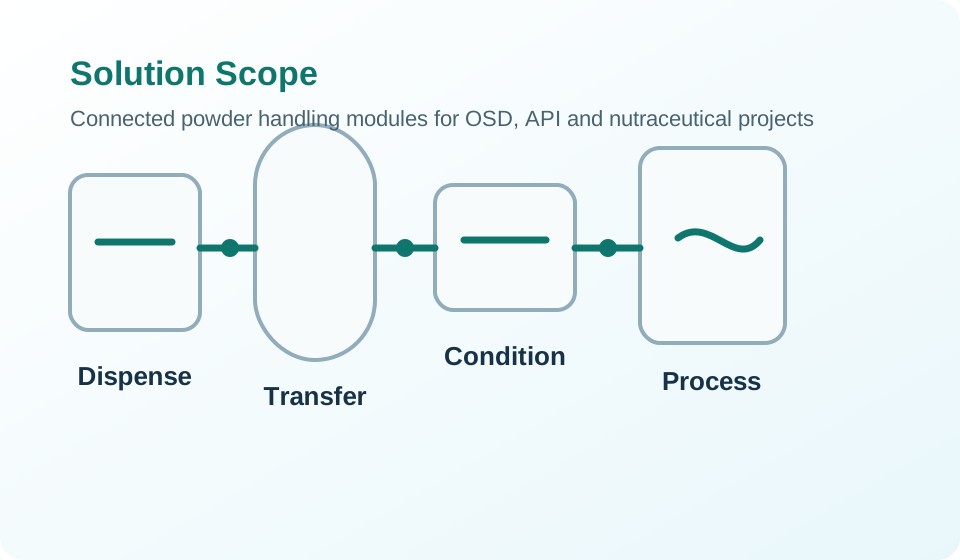
Short Answer
A blending and IBC handling system manages powder batches through bin charging, blending, discharge, transfer and downstream feed while reducing manual container handling.
Process position
Process Position
This solution sits after weighing, milling or sieving and before compression, encapsulation, granulation, packing or final transfer.
Step 1
IBC charging
Step 2
Bin blending
Step 3
IBC movement
Step 4
Discharge
Step 5
Downstream feed
Engineering review
Send Project Details For Equipment Or Line Selection
Send your URS, layout, BOQ, powder characteristics or required capacity. Our engineer will review the process step and suggest suitable powder handling equipment or a complete processing line concept.
Send Project Details For Engineering Review
Send your URS, layout, BOQ, powder characteristics or required capacity. Our engineer will review the process step and suggest suitable powder handling equipment or a complete processing line concept.
Applications, Benefits And Technical Options
Applications
- OSD blend preparation
- Nutraceutical premix blending
- API and excipient batch homogenization
- IBC-to-tablet press transfer
- Multi-batch production logistics
Key Benefits
- Reduced product transfers by using the IBC as process container
- Efficient batch movement between rooms and equipment
- Discharge and transfer options for difficult-flowing powders
- Line layouts can support multiple IBC sizes
- Documentation support for blender and bin packages
Technical Options
- IBC bin blender, lifting column and docking station
- Cone valve, butterfly valve or split valve discharge
- Load cells, bin ID, barcode and recipe options
- Vacuum conveying or gravity feed to downstream equipment
- Mobile wash station or cleaning support equipment
Quotation input
What Information Is Needed For Quotation
A clearer URS and layout package helps the engineering team confirm equipment scope, capacity assumptions, containment expectations and documentation needs.
Product name, powder properties, bulk density, particle size range and flowability notes.
Required capacity per batch or per hour, target transfer distance and elevation.
Process layout, room classification expectations and upstream/downstream equipment interfaces.
Containment, dust extraction, cleaning, material contact and documentation expectations.
Utilities, control preference, automation scope and FAT/SAT/IQ/OQ support requirements.
Ready To Discuss A Powder Handling Project?
Send your URS, layout, BOQ, powder characteristics or required capacity. Our engineer will review the process step and suggest suitable powder handling equipment or a complete processing line concept.
FAQ
Frequently Asked Questions
Can one blender handle different IBC sizes?+
Yes, within mechanical and process limits. IBC geometry, batch weight, center of gravity and docking design must be reviewed.
Can IBC discharge be contained?+
Yes. Split valves, cone valves, liners, docking seals and local extraction can be considered according to containment expectations.
Can one project combine several powder handling steps?+
Yes. Powder receiving, dispensing, transfer, sieving, milling, blending, granulation and drying can be combined as an integrated line when the process requires it.
Related guides
Related Guides
Use these Knowledge Hub articles to compare equipment options, prepare RFQ inputs and connect this page to the wider powder handling process.
What Is Pharmaceutical Powder Handling Equipment?
Pharmaceutical powder handling equipment moves, conditions, weighs, contains and feeds powders between process steps while supporting dust control, cleanability, operator workflow and GMP-oriented documentation.
Read guideHow To Design an OSD Powder Processing Line
An OSD powder processing line should be designed around batch flow, room layout, powder behavior, containment level, cleaning method and interfaces from dispensing through final feed.
Read guideVacuum Conveyor vs Pneumatic Conveyor
Vacuum conveying is commonly selected for enclosed pharmaceutical powder transfer over practical plant distances, while broader pneumatic conveying choices depend on capacity, route, powder behavior and containment needs.
Read guide