
API micronization and fine powder processing
Jet Mill for API Micronization and Fine Powder Processing
A fine powder micronization solution for API, DPI, pharmaceutical and high-value powder applications where particle size control requires technical evaluation.
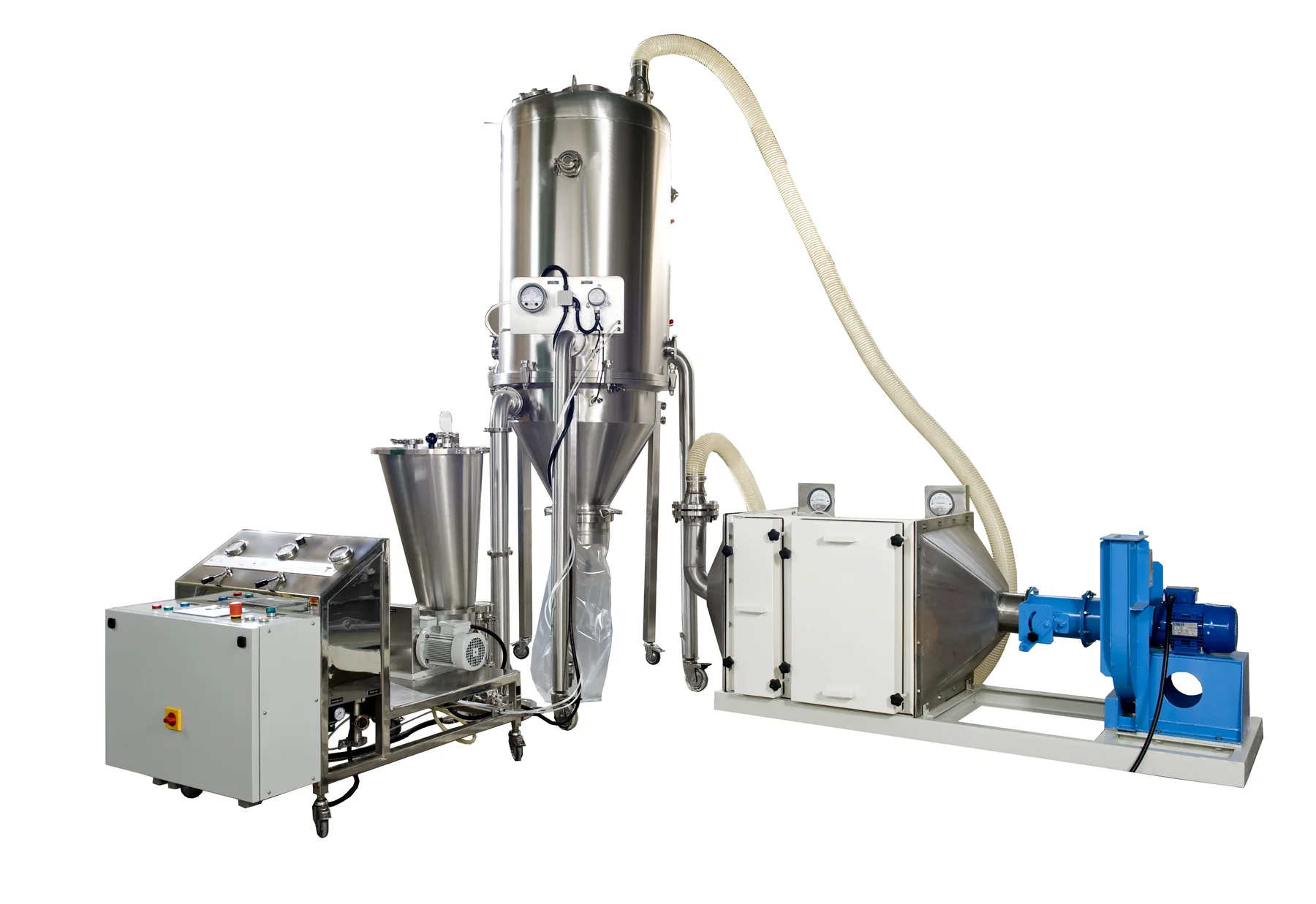
Fine Powder Micronization
Air or gas-driven micronization for API, DPI and high-value fine powder applications.
A jet mill is used for fine powder micronization by using high-speed compressed air or gas to accelerate particles and create particle-to-particle impact. For pharmaceutical applications, it is commonly evaluated for API, DPI and fine powder processing where particle size control, cleanability, dust control and documentation requirements are important. Final particle size results should be confirmed by material testing or technical evaluation.
Product Quick Summary
Application
API / DPI / fine powder micronization
Process type
Dry fine milling / micronization
Key evaluation
Material, target particle size and capacity to be confirmed by testing or technical evaluation
Testing
D50/D90/D97 testing available by internal or third-party testing
Options
SS316 contact parts, explosion-proof, nitrogen protection, feeding and collection system
Process position
Where A Jet Mill Fits In The Process
The jet mill is usually positioned after controlled feeding and before fine powder collection, blending, formulation or downstream containment steps when micronization or tight particle size evaluation is required.
Step 1
Material feeding
Step 2
Compressed air or gas acceleration
Step 3
Particle collision
Step 4
Classification
Step 5
Fine powder collection
Definition
What Is a Jet Mill?
A jet mill is a micronization machine used for fine milling and particle size control. Instead of using conventional mechanical grinding tools, it uses high-speed compressed air or gas to accelerate particles inside the milling chamber.
For pharmaceutical powder processing, a jet mill is commonly considered when API, DPI or high-value fine powders require technical evaluation around target particle size, cleanability, dust control and documentation needs.
The final equipment configuration should be selected according to material characteristics, customer URS and testing results where required.
Working principle
How a Jet Mill Works
Material is fed into the jet mill through a controlled feeding arrangement. Compressed air or gas accelerates particles to high speed, creating particle-to-particle collision inside the milling zone.
Reduced particles are separated through classification and collected through the selected collection system. Particle size depends on material behavior, feed condition, compressed air or gas parameters, classifier setting and model selection.
Compressed air or gas acceleration
Particle-to-particle collision
Classification and fine powder collection
Reduced particle size without conventional mechanical grinding media
Product media
Actual Jet Mill System Walkaround
This short walkaround shows an actual stainless steel Jet Mill system arrangement. Final feeding, gas supply, classification, collection and control scope depends on the material, target particle size, required capacity and approved technical proposal.
The media is provided for equipment and process reference. Final configuration may vary according to material characteristics, target particle size, capacity, containment requirements and the approved technical proposal.
Applications
Typical Applications
API micronization
DPI powder processing
Fine chemical powder processing
High-value fine powder materials
Pharmaceutical powder particle size control
Materials requiring fine milling without conventional mechanical grinding, if applicable
Material review
Suitable Materials
Jet mill suitability depends on material hardness, brittleness, moisture content, heat sensitivity, flowability and target particle size. Material testing or technical evaluation is recommended when performance is critical.
API powder
Inhalation-related powder evaluation
Fine chemical powder
Crystalline materials
High-value specialty powders
Heat-sensitive material to be evaluated case by case
Particle size and throughput
Target Particle Size & Capacity
The achievable particle size and capacity depend on material characteristics, feeding condition, compressed air or gas parameters, classifier setting and model selection. D50 / D90 / D97 results should be confirmed through internal or third-party particle size testing when required.
- Material name
- Identify product and industry use
- API, DPI, OSD, food or fine chemistry should be stated if known.
- Initial particle size
- Confirm feed size and feed condition
- Include any sieve or PSD data if available.
- Target particle size / D50 / D90 / D97
- To be confirmed by testing or technical evaluation
- D50/D90/D97 data can be discussed when required.
- Required capacity
- Confirm expected kg/h or batch need
- Capacity depends on material and model selection.
- Material hardness / brittleness
- Confirm milling behavior
- Crystalline, brittle or difficult materials may require testing.
- Moisture or oil content
- Confirm whether material is dry, sticky or oily
- High moisture or oily materials should be evaluated carefully.
- Heat sensitivity
- Confirm process risk
- Heat-sensitive products should be reviewed case by case.
- Feeding condition
- Confirm feeding method and flowability
- Flowability affects feeding stability and process evaluation.
- Collection and dust control needs
- Confirm collection, containment and dust extraction expectation
- Feeding, dust collection and powder collection systems can be configured according to customer requirements.
- Testing requirement
- Confirm internal or third-party testing need
- Third-party testing involves time and cost.
Equipment highlights
Key Features
Fine powder micronization
Particle size control through technical configuration
Suitable for API / DPI / fine chemical evaluation
SS316 contact parts available for pharmaceutical applications
Can be connected with feeding, collection and dust control systems according to project requirements
Material testing can be discussed before final model selection
Documentation support available after order confirmation according to project requirements
Optional explosion-proof or nitrogen protection configuration if required
Configuration
Technical Options
SS316 contact parts
Surface polishing according to project requirements
Feeding system
Collection system
Dust control
Classifier / process configuration
Explosion-proof option
Nitrogen protection option
Control system configuration
Internal or third-party particle size testing support
Pharmaceutical project review
Pharmaceutical Design Considerations
For pharmaceutical applications, jet mill selection should consider material contact parts, cleanability, contamination control, dust control, traceability and documentation needs.
GMP-oriented equipment design can be discussed according to customer URS and pharmaceutical production requirements. SS316 contact parts, polishing expectations, dust control and containment interfaces should be confirmed by project requirements.
Support scope
Cleaning, Documentation & Validation Support
User manual is supplied with the equipment.
FAT/SAT/IQ/OQ documentation, material certificates and validation-related documents can be provided after order confirmation according to project requirements.
Cleaning method should be confirmed according to equipment configuration and project requirements.
Cleaning and maintenance procedures should be confirmed based on the final equipment configuration.
If cleaning requires disassembly, the procedure and access points should be reviewed before final proposal.
Testing support
Material Testing & D50/D90/D97 Verification
Material testing is recommended when the target particle size is critical or when material behavior is uncertain.
D50 / D90 / D97 analysis can be discussed through internal or third-party testing depending on project requirements, time and cost. Test results are used to support equipment selection, process configuration and quotation scope.
When testing is recommended
- Target particle size is critical
- Material behavior is unknown
- Heat sensitivity or flowability is uncertain
- API / DPI / high-value powder evaluation
What can be reviewed
- Test equipment suitability
- Particle size distribution
- D50 / D90 / D97 if required
- Process feasibility
- Configuration recommendation
What customer should provide
- Material sample availability
- MSDS if available
- Initial particle size
- Target particle size
- Required capacity
- Testing objective
Selection logic
When to Choose a Jet Mill
A jet mill is not the default answer for every powder. It should be selected when the material and target result justify micronization evaluation.
Choose Jet Mill when
- Fine micronization is needed
- API / DPI / high-value powder application
- Target particle size requires technical evaluation
- Dust control and collection are important
- Material testing is available or recommended
Consider other equipment when
- Coarse size reduction is enough Hammer Mill
- Controlled delumping or sizing is needed Conical Mill
- Sieving / classification is the main purpose Turbo Sieving Mill
- Wet grinding / dispersion is needed Nano Bead Mill
Equipment selection comparison
Jet Mill vs Related Equipment
Hammer Mill
Best for: Coarse to medium size reduction
When to consider: Use when stronger mechanical impact milling is acceptable and micronization is not the main goal.
View detailsConical Mill
Best for: Controlled delumping or sizing
When to consider: Use when granules or powders need controlled sizing with gentler milling energy.
View detailsTurbo Sieving Mill
Best for: Sieving, classification and light homogenizing
When to consider: Use when the main objective is control sieving or oversize removal.
View detailsNano Bead Mill
Best for: Wet grinding and dispersion
When to consider: Use when a liquid phase, slurry or dispersion process is required.
View detailsRFQ information
What Information Is Needed for Jet Mill Quotation?
A. Material Information
- Material name
- MSDS if available
- Hardness / brittleness
- Moisture / oil content
- Heat sensitivity
B. Particle Size Requirement
- Initial particle size
- Target particle size
- D50 / D90 / D97 requirement if available
C. Production Requirement
- Capacity
- Batch or continuous operation
- Operating hours
- Dry process requirement
- Compressed air or gas supply condition
- Air pressure and air quality requirement
- Air consumption to be confirmed by model selection and process design
D. Project Requirement
- Contact material requirement
- Dust control / containment
- Explosion-proof / nitrogen protection
- Nitrogen supply requirement if nitrogen protection is needed
- Documentation needs
- Destination country
- Timeline
Internal links
Related Solutions
Material Testing & Equipment Selection
Best starting point when target particle size, material behavior or equipment selection is uncertain.
View detailsPharmaceutical Milling & Size Reduction System
Related solution page for milling, sieving, delumping and particle size conditioning.
View detailsAPI Micronization & Particle Size Control
Closest existing solution page for API powder handling, containment and fine powder project review.
View detailsFrequently asked questions
FAQ
What is a jet mill used for?+
A jet mill is used for fine powder micronization and particle size control by using compressed air or gas to create particle-to-particle impact.
Can a jet mill be used for API powder?+
Yes, a jet mill can be evaluated for API powder micronization, but suitability depends on material characteristics, target particle size, cleanability, containment and documentation requirements.
Can you guarantee the target particle size?+
No. Particle size results depend on material characteristics, feeding condition, compressed air or gas parameters and equipment configuration. Testing or technical evaluation is recommended before final confirmation.
Can D50/D90/D97 testing be provided?+
D50/D90/D97 testing can be discussed through internal or third-party testing, depending on project requirements, time and cost.
What information is needed before selecting a jet mill?+
Material name, initial particle size, target particle size, required capacity, hardness, brittleness, moisture, flowability, containment needs and any URS or layout information are important inputs.
When is material testing recommended?+
Material testing is recommended when target particle size is critical, material behavior is uncertain, or the project needs D50/D90/D97 data before model selection.
Can SS316 contact parts be provided?+
SS316 contact parts are available for pharmaceutical applications and should be confirmed together with product-contact scope and cleaning expectations.
Can FAT/SAT/IQ/OQ documents be provided?+
User manual is supplied with the equipment. FAT/SAT/IQ/OQ, material certificates and validation-related documents can be provided after order confirmation according to project requirements.
Can explosion-proof or nitrogen protection be configured?+
Explosion-proof and nitrogen protection options can be discussed according to material risk, project requirements and final equipment configuration.
How do I request a quotation?+
Send material name, initial particle size, target particle size, required capacity, process requirements, destination country and any layout, URS or testing objective through the RFQ form.
RFQ support
Send Your Material Information for Jet Mill Selection
Share your material name, initial particle size, target particle size, required capacity and process requirements. Our team will review whether a jet mill or another milling solution is suitable.