
Controlled drying after wet granulation
Fluid Bed Dryer
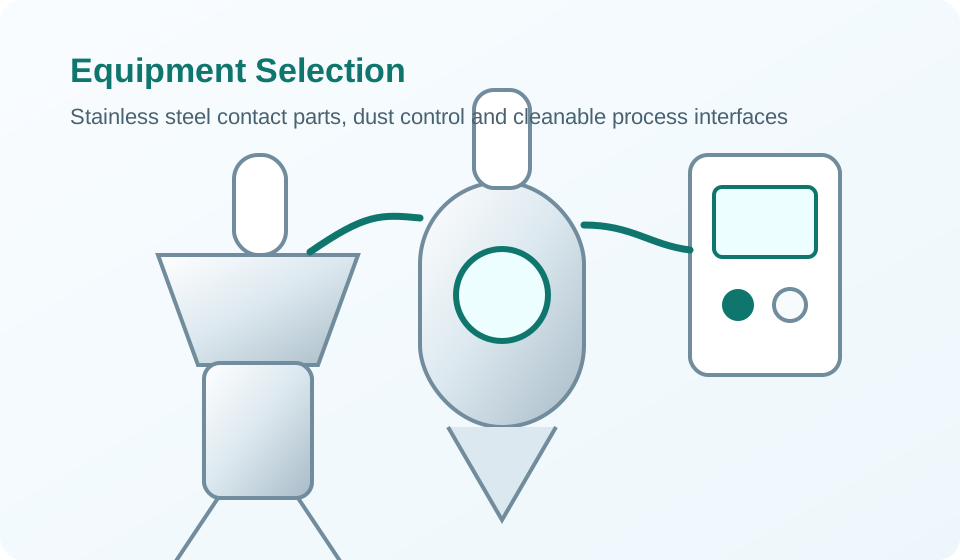
Fluid bed dryer for pharmaceutical wet granules with drying, discharge, milling and transfer integration for OSD production lines.
Short Answer
A fluid bed dryer dries wet granules using controlled process air before discharge to milling, sieving, blending or final transfer steps.
Process position
Process Position
The dryer sits after wet granulation and before dry milling, sieving, blending or downstream container handling.
Step 1
Wet granule feed
Step 2
Fluidized drying
Step 3
Moisture endpoint
Step 4
Discharge
Step 5
Sizing or blending
Applications, Benefits And Technical Options
Applications
- OSD wet granule drying
- Pilot and production granulation lines
- Drying before cone milling
- Batch drying with process monitoring
- Granule discharge to IBC or transfer system
Key Benefits
- Controlled drying step for wet granulation workflows
- Air handling and filtration options selected by process need
- Discharge can interface with mills, sifters or IBCs
- Automation options for recipe and process monitoring
- Designed as equipment-only or full line package
Technical Options
- Inlet air handling, heating and humidity options
- Product bowl sizes selected by batch volume
- Bag filters, shaking or pulse cleaning options
- Exhaust filtration and solvent-risk review where applicable
- WIP/CIP and qualification documentation options
Quotation input
What Information Is Needed For Quotation
A clearer URS and layout package helps the engineering team confirm equipment scope, capacity assumptions, containment expectations and documentation needs.
Product name, powder properties, bulk density, particle size range and flowability notes.
Required capacity per batch or per hour, target transfer distance and elevation.
Process layout, room classification expectations and upstream/downstream equipment interfaces.
Containment, dust extraction, cleaning, material contact and documentation expectations.
Utilities, control preference, automation scope and FAT/SAT/IQ/OQ support requirements.
Ready To Discuss A Powder Handling Project?
Send your URS, layout, BOQ, powder characteristics or required capacity. Our engineer will review the process step and suggest suitable powder handling equipment or a complete processing line concept.
FAQ
Frequently Asked Questions
What determines fluid bed dryer capacity?+
Capacity depends on wet batch load, moisture content, drying target, air volume, temperature limits, product behavior and cleaning cycle.
Can the dryer discharge directly to a cone mill?+
Yes. Direct discharge to a cone mill or transfer system can be considered if layout, height and cleaning access allow it.
Is documentation support available for pharmaceutical projects?+
Documentation support can be included according to project scope, including drawings, material certificates, FAT/SAT records and IQ/OQ support if required.
Related guides
Related Guides
Use these Knowledge Hub articles to compare equipment options, prepare RFQ inputs and connect this page to the wider powder handling process.
Cone Mill vs Hammer Mill
Cone mills are often used for controlled delumping and granule sizing, while hammer mills are used for more aggressive size reduction. Selection depends on target particle size, heat sensitivity, containment and cleaning needs.
Read guideWhat Is Pharmaceutical Powder Handling Equipment?
Pharmaceutical powder handling equipment moves, conditions, weighs, contains and feeds powders between process steps while supporting dust control, cleanability, operator workflow and GMP-oriented documentation.
Read guideHow To Design an OSD Powder Processing Line
An OSD powder processing line should be designed around batch flow, room layout, powder behavior, containment level, cleaning method and interfaces from dispensing through final feed.
Read guide